1D vs. 2D Barcode Scanners: What’s the Difference?
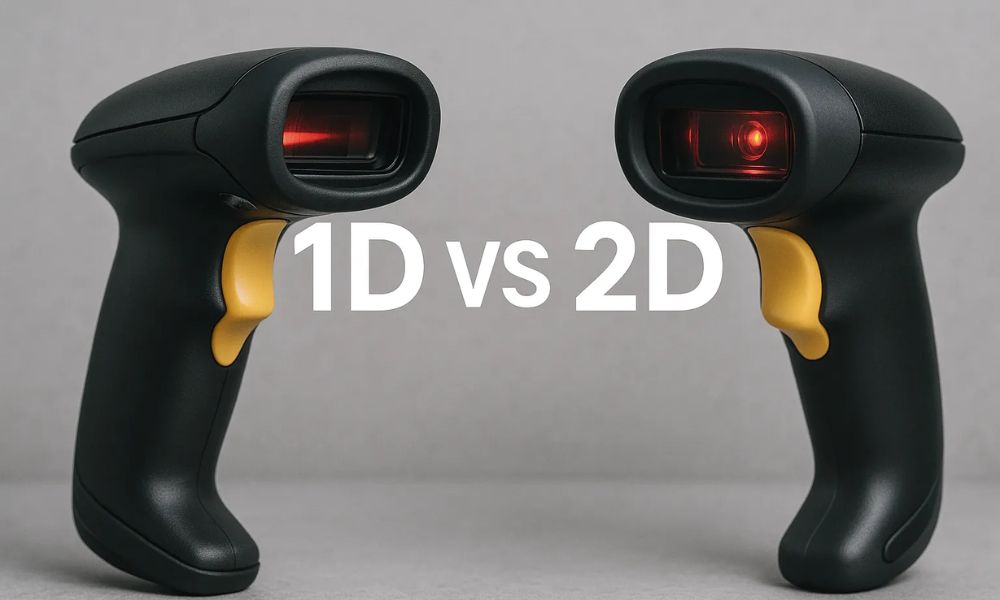
Picture this: you’re at a grocery store checkout, and the cashier swiftly scans the barcode on your items. That simple beep is the result of a fascinating technology that comes in two main types-1D and 2D barcode scanners. But what exactly sets these two apart? And why does it matter for businesses and consumers alike?
What Are 1D and 2D Barcodes?
a. 1D Barcodes: The Classic Lines
1D barcodes, also known as linear barcodes, are the familiar series of vertical lines and spaces you see on almost every product. Each line’s thickness and spacing represent numbers or characters, encoding information in a single dimension—horizontally. These barcodes have been around since the 1970s and remain widely used in retail, logistics, and inventory management.
Common examples include the Universal Product Code (UPC) and the European Article Number (EAN). These barcodes typically store a limited amount of data—usually just a product number or identifier that links to a database. The simplicity of 1D barcodes makes them easy to scan with basic laser scanners, which is why they have become a staple in checkout lines and warehouse operations. However, their limited data capacity can be a drawback in scenarios where more information needs to be conveyed, leading to the development of more advanced barcode technologies.
b. 2D Barcodes: The Matrix of Information
Unlike 1D barcodes, 2D barcodes encode data both horizontally and vertically. This means they can store much more information in a smaller space. Instead of lines, 2D barcodes use patterns of squares, dots, hexagons, or other shapes arranged in a grid. This multidimensional approach allows for a significant increase in data capacity, making them ideal for applications that require more detailed information.
Popular 2D barcode types include QR codes, Data Matrix, and PDF417. These codes can hold a variety of data types, such as URLs, text, contact details, or even entire documents. Because of their versatility, 2D barcodes are increasingly common in mobile payments, ticketing, and product authentication. For instance, QR codes have become ubiquitous in advertising, allowing consumers to quickly access websites or promotional content simply by scanning the code with their smartphones. Additionally, the ability to store complex data makes 2D barcodes a preferred choice in industries like healthcare, where they can be used to track patient information and medication details, enhancing both efficiency and safety in medical settings.
How Do 1D and 2D Barcode Scanners Work?
a. The Mechanics Behind 1D Scanners
1D barcode scanners use a laser beam that sweeps across the barcode. The scanner detects the reflected light, interpreting the pattern of dark bars and light spaces. Since 1D barcodes are linear, the scanning process is relatively straightforward—just a single line of data to read.
These scanners are fast and reliable for reading standard barcodes on products. However, they require the barcode to be aligned properly, usually horizontally, for accurate scanning. This alignment is crucial, as any tilt or misalignment can lead to scanning errors, causing delays in checkout lines or inventory management. Additionally, 1D scanners are often used in retail environments, warehouses, and logistics, where efficiency is key. Their simplicity and cost-effectiveness make them a popular choice for businesses looking to streamline operations without investing heavily in technology.
b. How 2D Scanners Capture More Data
2D barcode scanners use imaging technology, often similar to a digital camera. They capture a picture of the entire barcode and then use software algorithms to decode the complex patterns. This method allows them to read codes from any angle and even from damaged or partially obscured barcodes.
Because 2D scanners process images rather than just light reflections, they can handle a wider variety of barcode types and sizes. This flexibility makes them ideal for applications where quick, accurate scanning is essential. For instance, in the healthcare industry, 2D scanners can read QR codes on patient wristbands, ensuring accurate medication administration. Furthermore, the ability to scan multiple codes simultaneously enhances productivity, particularly in busy environments like warehouses or retail stores. As technology advances, 2D scanners are also becoming more integrated with mobile devices, allowing for seamless data capture and management on the go, which is revolutionizing how businesses operate in the digital age.
Key Differences Between 1D and 2D Barcode Scanners
a. Data Capacity and Complexity
One of the biggest differences lies in how much information each barcode type can hold. 1D barcodes are limited to around 20-25 characters, which is enough for simple product IDs or serial numbers. In contrast, 2D barcodes can store hundreds or even thousands of characters, including alphanumeric data and special characters.
This expanded capacity means 2D barcodes can carry entire URLs, contact information, or even encrypted data. For businesses that need to track detailed product information or provide interactive customer experiences, 2D barcodes offer a significant advantage. Additionally, the ability to encode more complex data allows companies to create more engaging marketing campaigns. For example, a 2D barcode on a product can link to a video tutorial, customer reviews, or promotional offers, enhancing customer engagement and providing valuable information at the point of sale.
b. Scanning Speed and Accuracy
1D scanners are generally faster when reading simple, well-printed barcodes. Their laser technology quickly reads the linear pattern, making them suitable for high-volume retail environments. However, they struggle with damaged, poorly printed, or misaligned barcodes.
2D scanners, while sometimes slightly slower due to image processing, excel in accuracy and versatility. They can read barcodes from screens, curved surfaces, or even damaged labels. This makes them ideal for industries like healthcare, manufacturing, and logistics, where barcode conditions vary widely. Moreover, the ability of 2D scanners to capture multiple barcodes in a single scan can significantly streamline operations, reducing the time spent on inventory management and improving overall workflow efficiency.
c. Cost and Implementation
1D barcode scanners are typically less expensive and simpler to deploy. Their long history and widespread use mean they are readily available and supported by most point-of-sale systems.
2D scanners, with their advanced imaging technology, usually come at a higher price point. However, the cost gap has been narrowing as technology advances. For businesses requiring more complex data capture, the investment in 2D scanning often pays off through improved efficiency and new capabilities. Furthermore, as industries increasingly adopt automation and digital transformation, the integration of 2D barcode scanning technology can provide a competitive edge. Companies can leverage data analytics derived from 2D barcodes to gain insights into customer behavior, inventory turnover, and supply chain efficiency, ultimately driving better business decisions and strategies.
When to Choose 1D Barcode Scanners
a. Retail and Simple Inventory Systems
If your business primarily handles products with standard UPC or EAN barcodes, 1D scanners are often sufficient. They offer fast, reliable scanning for checkout counters, warehouses, and stockrooms. For example, grocery stores and bookstores typically rely on 1D scanning technology. These scanners can easily read barcodes from various surfaces, including paper labels and plastic packaging, making them versatile tools in a retail environment. Additionally, their speed ensures that customer wait times are minimized during busy shopping hours, enhancing overall customer satisfaction.
Moreover, 1D barcode scanners are often integrated with point-of-sale (POS) systems, allowing for seamless data entry and inventory management. This integration not only streamlines the checkout process but also helps in tracking sales trends and inventory levels in real-time. As a result, businesses can make informed decisions regarding stock replenishment and promotional strategies, ultimately driving sales and improving operational efficiency.
b. Cost-Sensitive Environments
When budget constraints are tight, and the scanning needs are straightforward, 1D scanners provide a cost-effective solution. Their durability and simplicity make them a practical choice for small businesses or temporary setups. Many 1D scanners are designed to withstand drops and spills, which is particularly beneficial in environments like warehouses or outdoor markets where equipment may be subjected to rough handling.
In addition to their affordability, 1D scanners often have lower maintenance costs compared to more complex scanning systems. They require minimal training for staff, allowing new employees to become proficient quickly without extensive onboarding. This ease of use can significantly reduce operational downtime and ensure that your workforce remains productive. Furthermore, as businesses grow, many 1D scanners can be easily upgraded or integrated with more advanced systems, providing a flexible solution that can adapt to changing needs without requiring a complete overhaul of existing technology.
When to Choose 2D Barcode Scanners
● Complex Data Needs
Businesses that require detailed product tracking, such as serial numbers, batch codes, or expiration dates, benefit from 2D barcode scanners. Pharmaceutical companies, electronics manufacturers, and logistics providers often use 2D codes to improve traceability and compliance.
● Mobile and Digital Integration
2D barcodes are perfect for mobile applications. QR codes on smartphones enable quick access to websites, payment systems, or promotional content. Events and transportation services use 2D codes for ticketing and boarding passes, where scanning speed and flexibility are crucial.
● Challenging Scanning Conditions
In environments where barcodes may be damaged, dirty, or printed on curved surfaces, 2D scanners shine. Their imaging technology can decode barcodes that 1D scanners would miss, reducing errors and delays.
Future Trends and Considerations
● Growing Adoption of 2D Barcodes
As digital transformation accelerates, 2D barcodes are becoming more prevalent. Their ability to hold rich data and interact with mobile devices aligns well with modern business needs. Expect to see more industries adopting 2D scanning for inventory management, customer engagement, and security.
● Hybrid Scanners: The Best of Both Worlds
Some devices now combine 1D and 2D scanning capabilities, allowing businesses to handle a wide range of barcode types without switching equipment. These hybrid scanners offer flexibility and future-proofing, especially in environments with diverse scanning needs.
● Integration with Emerging Technologies
Barcode scanning is increasingly integrated with technologies like augmented reality (AR), blockchain, and the Internet of Things (IoT). This integration enhances supply chain transparency, product authenticity, and customer experiences, pushing the boundaries of what barcode technology can achieve.
Conclusion: Choosing the Right Scanner for Your Needs
Deciding between 1D and 2D barcode scanners boils down to your specific requirements. If your operation revolves around simple product identification with standard barcodes, 1D scanners offer speed and affordability. But if you need to capture more complex data, improve scanning accuracy, or engage with digital platforms, 2D scanners are the smarter choice.
Understanding these differences helps businesses make informed decisions that boost efficiency, reduce errors, and open new opportunities. Whether it’s a small retail shop or a large logistics company, the right barcode scanner can make all the difference.

 March 27, 2026
 March 20, 2026
 March 15, 2026
 March 10, 2026
 February 27, 2026
 February 23, 2026